Audio Deep Learning
A clear and systematic path from raw audio signals to deep learning models.
Audio is one of the most information-dense and expressive data modalities we encounter in the real world. Speech, music, and environmental sounds carry structure across time, frequency, rhythm, and semantics. Yet, compared to vision and text, audio has historically felt opaque to many machine learning practitioners. While image pipelines are well standardized and text pipelines are now dominated by tokenization and transformers, audio often appears fragmented across signal processing theory, domain-specific heuristics, and ad hoc feature engineering.
This blog is written to remove that friction.
The goal of this series is to provide a clear and systematic path from raw audio signals to deep learning models, with a strong emphasis on intuition, representations, and practical modeling decisions. We begin with first principles of signal processing, build up the mathematical and perceptual foundations of audio, and progressively connect them to modern deep learning systems used in speech, music, and multimodal learning.
This is not a collection of isolated tricks or recipes. Instead, it is a structured narrative that explains why audio representations look the way they do, how models consume them, and what tradeoffs arise at each stage of the pipeline.
What Is Audio Data
At its core, audio is a time-varying signal that represents changes in air pressure captured by a sensor. When digitized, this signal becomes a discrete sequence of amplitude values sampled at a fixed rate. Unlike images, which are spatially localized, audio is inherently temporal. Meaning emerges not from a single sample, but from patterns across time.
This temporal nature introduces several challenges for machine learning.
First, raw waveforms are high resolution and redundant. Second, perceptually meaningful structure such as pitch, timbre, and rhythm is not explicit in the time domain. Third, many tasks depend on both short-term patterns such as phonemes and long-term context such as words, sentences, or musical form.
Because of this, most audio-based learning systems rely on intermediate representations that reorganize the signal into forms that expose relevant structure. Understanding these representations is essential before introducing neural architectures.
Audio is not naturally aligned with how humans perceive sound. Most learning systems therefore operate on transformed representations rather than raw waveforms.Why Audio for Deep Learning Is Different
In image modeling, convolutional inductive biases align well with spatial locality. In text, tokenization and self-attention map naturally to symbolic structure. Audio, however, sits at the boundary between continuous physics and discrete semantics.
Historically, audio machine learning depended heavily on handcrafted features derived from digital signal processing. Examples include spectral descriptors, cepstral coefficients, and energy-based statistics. These features worked well, but often obscured the relationship between raw signals and model behavior.
Deep learning changes this balance. Modern systems increasingly learn representations directly from data, but they still depend on signal processing concepts such as time-frequency analysis, windowing, and perceptual scaling. Ignoring these foundations leads to brittle models and poor generalization.
This blog therefore treats signal processing not as a legacy artifact, but as a first-class abstraction layer that interacts directly with neural networks.
Audio Deep Learning Use Cases
Before diving into theory, it is useful to ground the discussion in concrete applications. Audio deep learning systems typically follow a pipeline where raw waveforms are transformed, encoded, and mapped to task-specific outputs.
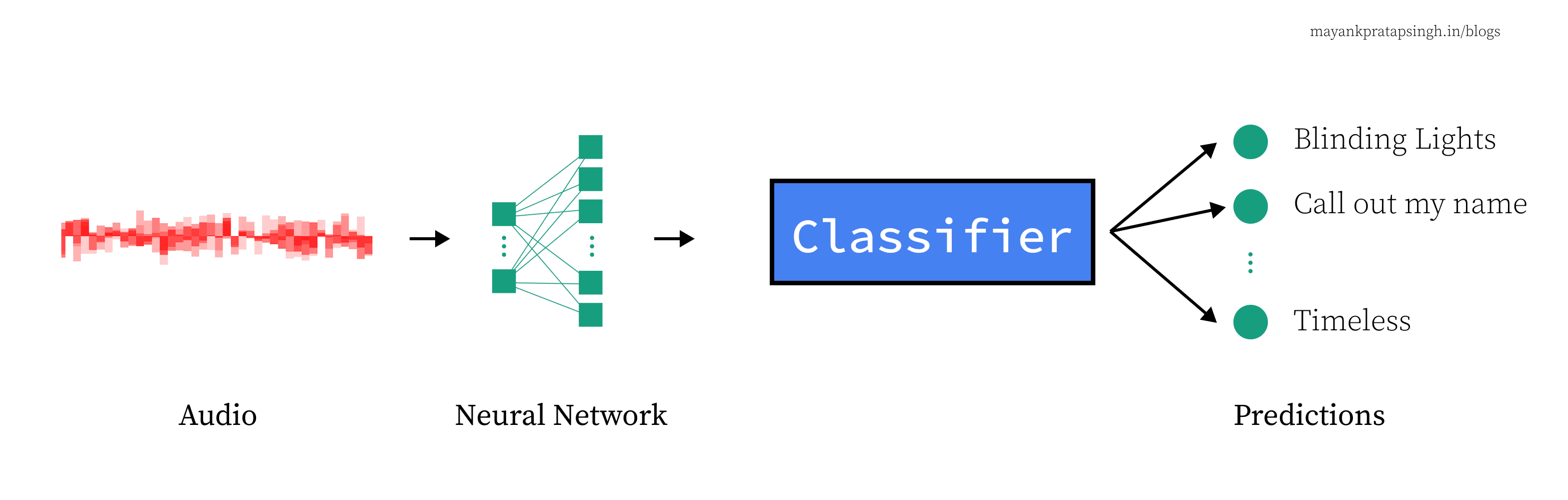 Figure 1.1: A high-level audio classification pipeline where raw audio is transformed, encoded by a neural network, and mapped to discrete semantic labels such as speaker identity, keyword, or music track.
This pattern appears in keyword spotting, music tagging, acoustic scene classification, and speaker recognition.
Currently, speech interactions are becoming more common.
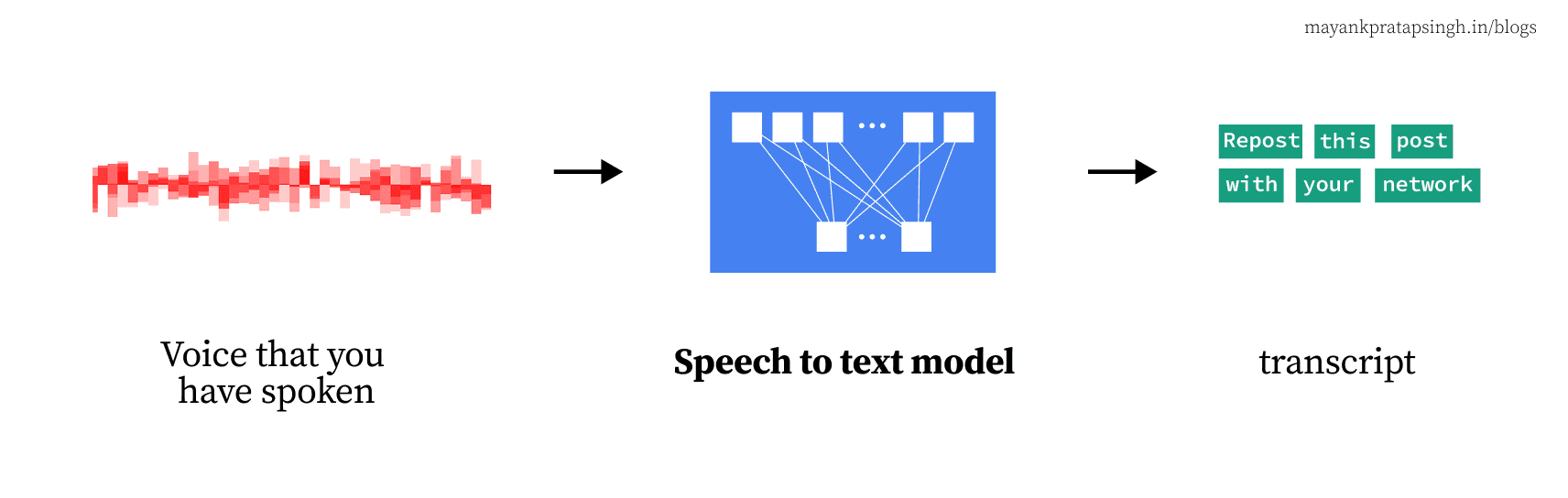 Figure 1.2: A speech recognition system that converts spoken audio into a text transcript using a learned acoustic model and language modeling components.
Speech recognition transforms continuous signals into symbolic sequences and serves as a bridge between audio and language models.
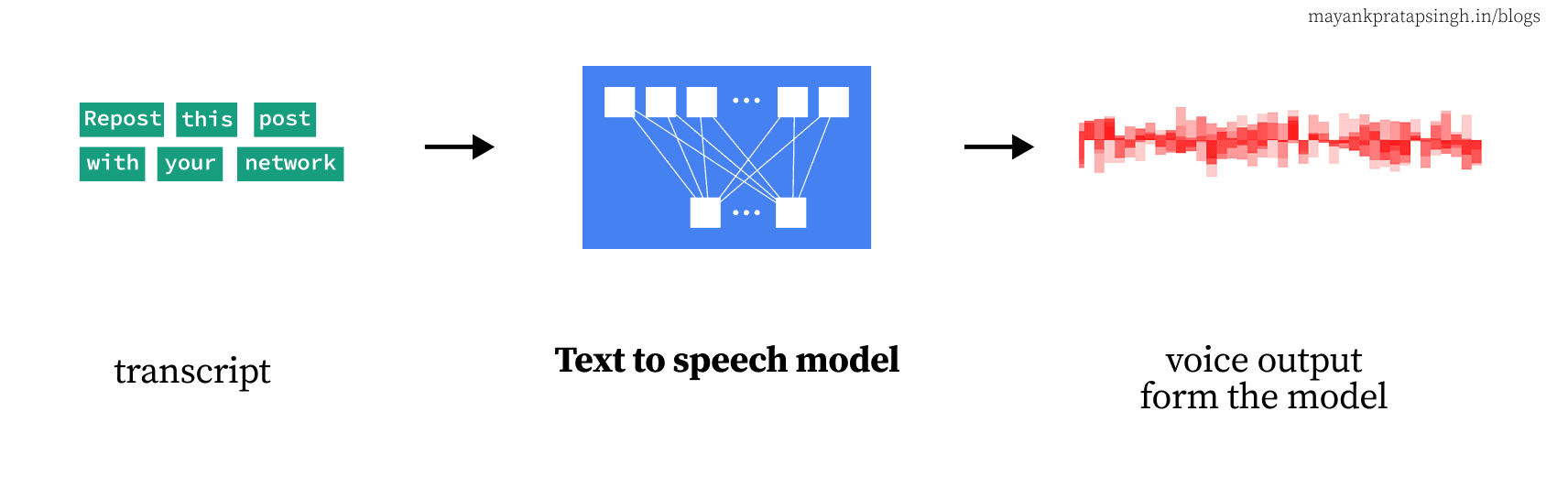 Figure 1.3: A text to speech pipeline that generates audio waveforms from text inputs, often using intermediate acoustic representations and neural vocoders.
Text to speech systems illustrate how learned audio representations can be inverted back into signals.
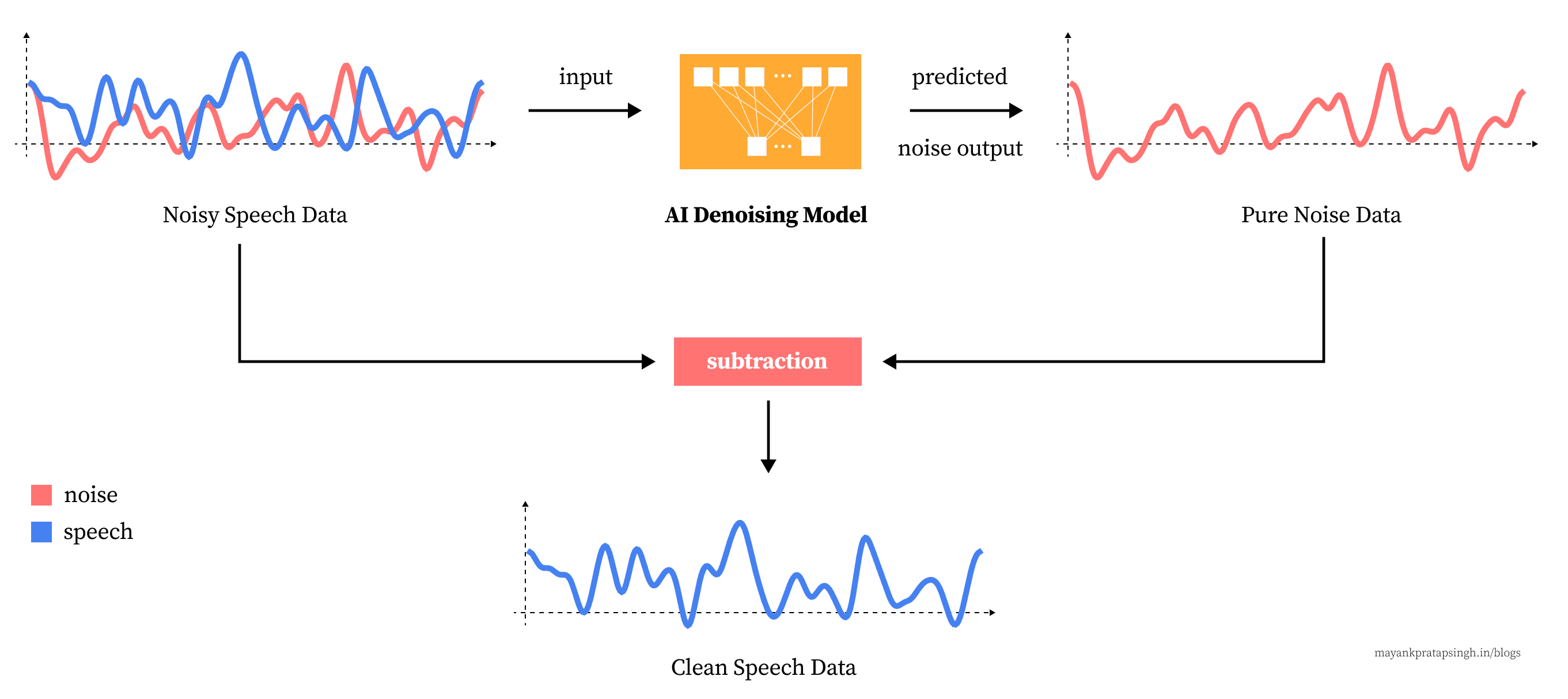 Figure 1.4: An audio denoising system that separates clean speech from background noise by predicting and removing noise components from the signal.
Denoising models demonstrate regression-style learning directly in the signal or spectral domain.
Beyond these examples, audio deep learning is used in music information retrieval, sound event detection, spatial audio, voice conversion, emotion recognition, and increasingly in multimodal systems where audio interacts with vision and language models.
Scope and Structure of This Blog
This blog is focused specifically on audio for deep learning, not general digital signal processing and not classical audio engineering. Every concept introduced is motivated by its role in machine learning systems.
The progression is deliberate.
- We begin with basic signal representations and sampling.
- We move into time and frequency domain analysis.
- We introduce perceptually motivated representations.
- We connect these representations to neural architectures.
- We discuss how modern audio models fit into multimodal systems.
Throughout the blog, interactive visualizations are used to make abstract concepts concrete. Many ideas in audio are easier to understand visually than algebraically, and the content is designed to take advantage of this.
The objective is not to memorize audio features, but to understand why they exist and when to use them.How to Read This Blog
This series assumes familiarity with basic machine learning concepts and a working knowledge of Python. Prior experience with signal processing is helpful but not required. Mathematical details are introduced only when they clarify intuition or design choices.
Readers are encouraged to interact with the visualizations, experiment with parameters, and revisit earlier sections as new concepts build on previous ones. Audio understanding compounds over time, much like language or vision.
By the end of this blog, a spectrogram should feel as interpretable as an image tensor, and audio models should feel like a natural extension of modern deep learning practice rather than a specialized niche.
Newsletter
Stay in the loop
Get notified when new chapters drop. No spam, unsubscribe anytime.