Periodic and Aperiodic Sounds
Understanding the distinction between periodic and aperiodic signals in audio.
Periodic and Aperiodic Sounds
Not all sounds behave the same way over time. A fundamental distinction in audio signal processing is whether a sound is periodic or aperiodic. This distinction plays a critical role in how audio is represented, analyzed, and modeled in machine learning systems.
Periodic sounds repeat a pattern at regular intervals. They are characterized by a well defined fundamental frequency and harmonically related components. Musical notes, sustained vowels in speech, and tuning fork tones fall into this category. In contrast, aperiodic sounds do not exhibit repeating structure. Their energy is spread irregularly across time and frequency, as seen in noise, percussive transients, and many environmental sounds.
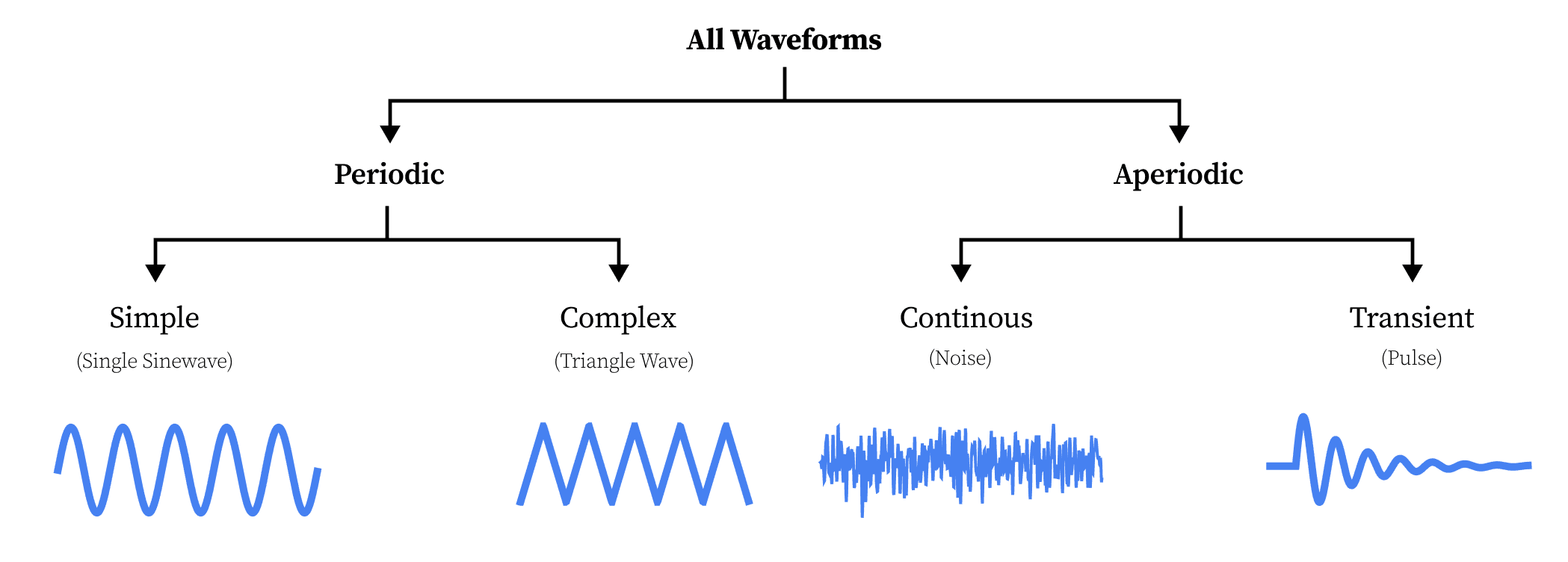 Figure 1.8: Taxonomy of waveform types, dividing all signals into periodic and aperiodic classes, with further separation into simple and complex periodic waves, and continuous and transient aperiodic signals.
This classification is not merely descriptive. Periodic signals are well suited to frequency based representations, while aperiodic signals often require time localized analysis. Many real world sounds lie between these extremes, combining periodic and aperiodic components.
Listening to Waveform Categories
The waveform visualizer accompanying this section allows direct interaction with these signal classes. Each panel represents a distinct waveform family, including simple periodic waves such as sine tones, complex periodic waves such as triangle waves, continuous aperiodic noise, and transient aperiodic pulses.
Periodic: Simple
Pure frequency, no harmonics.
Periodic: Complex
Odd harmonics, scaling by 1/n^2.
Aperiodic: Continuous
Equal energy per frequency.
Aperiodic: Transient
Short burst of efficient energy.
Interactive demonstration of fundamental waveform categories.
Use the play controls to listen to each waveform while observing its time domain structure. Adjust frequency, gain, or duration to understand how periodicity manifests visually and perceptually. For example, increasing frequency tightens waveform repetition, while transient signals concentrate energy into short time spans.
This hands on comparison builds intuition that will be essential later when interpreting spectrograms, designing audio features, and selecting model architectures for different audio tasks.
Newsletter
Stay in the loop
Get notified when new chapters drop. No spam, unsubscribe anytime.