Timbre and the Character of Sound
Understanding timbre as the quality of sound.
Timbre and the Character of Sound
So far, we have described sound using measurable quantities such as frequency, amplitude, and phase. However, these parameters alone are not sufficient to explain why two sounds with the same pitch, loudness, and duration can still be perceived as fundamentally different. This perceptual distinction is captured by timbre.
Timbre, sometimes referred to as tone color, is the quality of a sound that allows us to distinguish between different sound sources even when they produce the same note at the same intensity. For example, a piano and a guitar playing the same pitch at the same loudness are immediately recognizable as different instruments. This difference does not arise from frequency or amplitude, but from how energy is distributed and evolves over time.
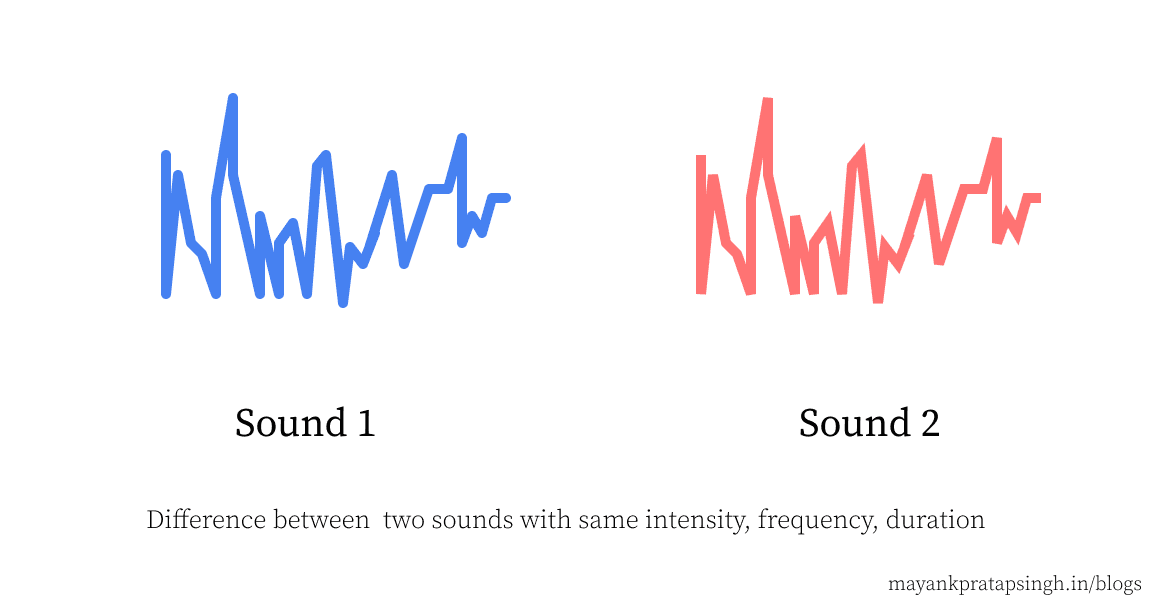 Figure 1.13: Two sounds with identical intensity, frequency, and duration, yet clearly different perceived character. Timbre accounts for this difference.
Timbre as an Analogy of Color
A useful way to understand timbre is through analogy. Just as color distinguishes objects that share the same shape, timbre distinguishes sounds that share the same basic acoustic parameters.
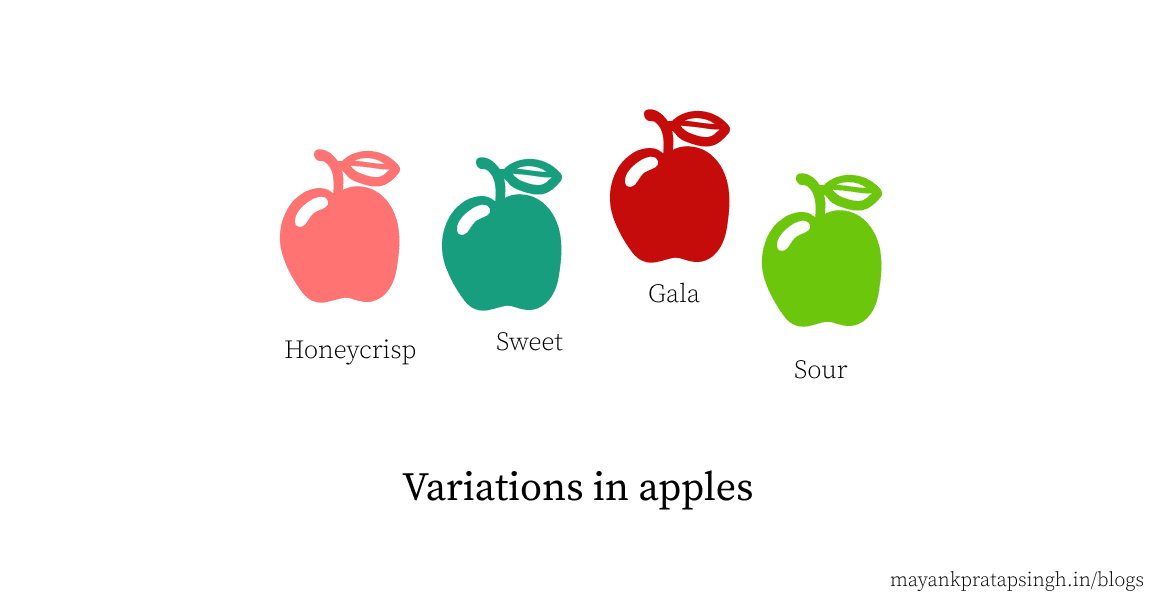 Figure 1.14: An analogy between sound timbre and variations in apples. All apples belong to the same category, yet differ in sweetness, color, and texture.
All apples are recognizably apples, yet Honeycrisp, Gala, and sour green apples differ in taste and texture. In the same way, musical instruments and voices belong to broad categories, but each exhibits distinct tonal characteristics. Even two instruments of the same type can sound different depending on construction, playing technique, or performer.
This analogy is particularly useful in machine learning, where models must learn to discriminate subtle variations within the same sound class, such as different speakers, instruments, or acoustic environments.Temporal Shape and the ADSR Envelope
One of the most important contributors to timbre is how a sound evolves over time. This evolution is commonly described using the ADSR envelope, which models the amplitude trajectory of a sound.
- Attack: Describes how quickly the sound reaches its peak after being triggered.
- Decay: Describes how quickly the sound falls from the peak to a steady level.
- Sustain: Represents the level maintained while the sound is active.
- Release: Describes how the sound fades after the source stops.
In the interactive ADSR visualizer below, you can adjust each envelope parameter and immediately hear and see its effect. Short attacks and releases produce percussive, plucked sounds, while long attacks and sustained releases produce smooth, pad-like textures.
Experimenting with these controls makes it clear that timbre is not a static property, but a dynamic one shaped by time-varying structure.
ADSR Envelope
Timbre as a Foundation for Complex Sound Representations
From a signal processing perspective, timbre emerges from a combination of harmonic content, spectral distribution, and temporal dynamics. These properties are not directly visible in simple waveforms but become apparent through more advanced representations such as spectra and spectrograms.
In deep learning systems, timbre is rarely encoded explicitly. Instead, models learn to infer it implicitly from time-frequency patterns. Understanding timbre at this foundational level prepares us to reason about why certain representations work well for tasks such as instrument recognition, speaker identification, and audio synthesis.
With this, we complete the core vocabulary of sound. In the next section, we move from descriptive parameters to structural composition, exploring how complex sounds are formed from simpler components.
Newsletter
Stay in the loop
Get notified when new chapters drop. No spam, unsubscribe anytime.